 MYSTIC ROSE
I · Orders & talismans
A portable world
between faith and form.
Long before a modern tracker slipped into a polished case, people wore small objects close to the body because closeness mattered. A pendant could carry a prayer, a relic, a name, a seal or a memory. A Byzantine reliquary cross in The Metropolitan Museum of Art was itself an opening container: it once held a tiny devotional relic and was worn as protection.
Orders gave these objects a shared language. Medieval religious orders used crosses, seals and relics as signs of vow and belonging. Later legends transformed the Knights Templar into keepers of every imaginable secret; the documented story is more restrained. Their surviving identity rests on a military-religious order, its rule and its cross — while many “Templar talismans” sold today belong to modern romance.
The Rosicrucian manifestos appeared in Germany in 1614–1615, joining the rose and cross to a programme of spiritual and intellectual renewal. By the late nineteenth century, the Hermetic Order of the Golden Dawn developed an initiatory system in which colours, planetary correspondences, divine names and geometric diagrams could be assembled into consecrated talismanic designs.
What an order gives the object is a grammar. What the wearer gives it is a life.
History note. Symbols travel between movements, and later organisations often reinterpret earlier ones. Resemblance is not proof of a single unbroken secret lineage.
II · Cats of ancient Egypt
The guardian
who could purr.
Ancient Egyptians did not worship every household cat as a god. They recognised feline qualities in divinity. Bastet could appear as a cat or cat-headed woman and was associated with protection, prosperity, women and children. Her cult centre was Bubastis.
Museum collections preserve the intimacy of that relationship. Small faience cat amulets were pierced or looped for suspension. Bronze cat figures could wear broad collars, earrings and wedjat-eye pendants — beauty and protection resting on the same chest.
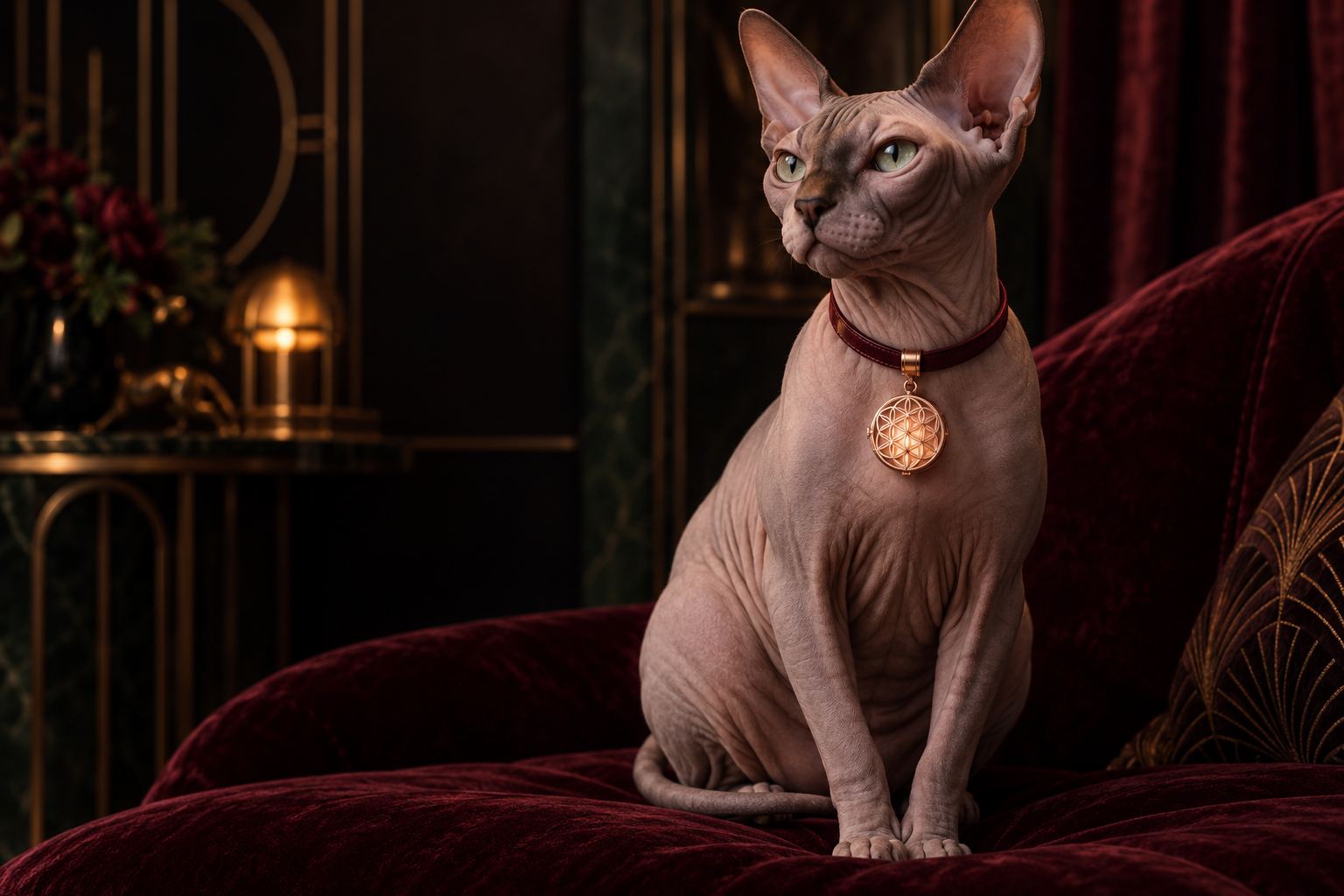
That image gives Indie’s portrait its quiet historical rhyme: a watchful cat, a jewel near the heart, and light carried through darkness.
III · Flower of Life
Ancient circles.
A modern name.
The geometry begins simply: equal circles repeat on a triangular grid. Their intersections create lenses, six-petal rosettes, hexagons and the familiar nineteen-circle field now called the Flower of Life.
Compass-drawn interlocking-circle ornament is genuinely old and geographically widespread. A British Museum door-sill from the ancient Near East, for example, carries a field of intersecting circles that produces six-petalled flowers.
The exact title “Flower of Life” and the spiritual system surrounding the nineteen-circle emblem are modern. Claims that every ancient civilisation shared one secret doctrine go farther than the surviving evidence. The honest wonder is already immense: one radius, repeated faithfully, can create a living field.
The Mystic Rose reading
Old instinct.
New purpose.
The new Talisman keeps the ancient instinct — carry meaning close — while leaving technology in the owner’s hands. Its case opens for the compatible tracker you already use. A gentle turn is imagined to awaken the Flower of Life in light.
Selected sources
History is part of the beauty. These museum and research records ground the story above.
The Met — Byzantine pendant reliquary cross↗University of Arizona — the Rosicrucian manifestos↗Golden Dawn Library — historical texts and rituals↗The Met — Egyptian cat amulet, c. 1080–664 BCE↗The Met — Bastet cat with a wedjat amulet↗British Museum — Bastet cat amulet↗British Museum — compass-drawn interlocking-circle ornament↗