 MYSTIC ROSE
Tarot · History & creators · 18 October 2026 · 5 min
Tarot: from playing cards to a digital language of symbols
Tarot history, Heiti Kender’s interactive creation and the Mystic Rose Cleopatra card system.
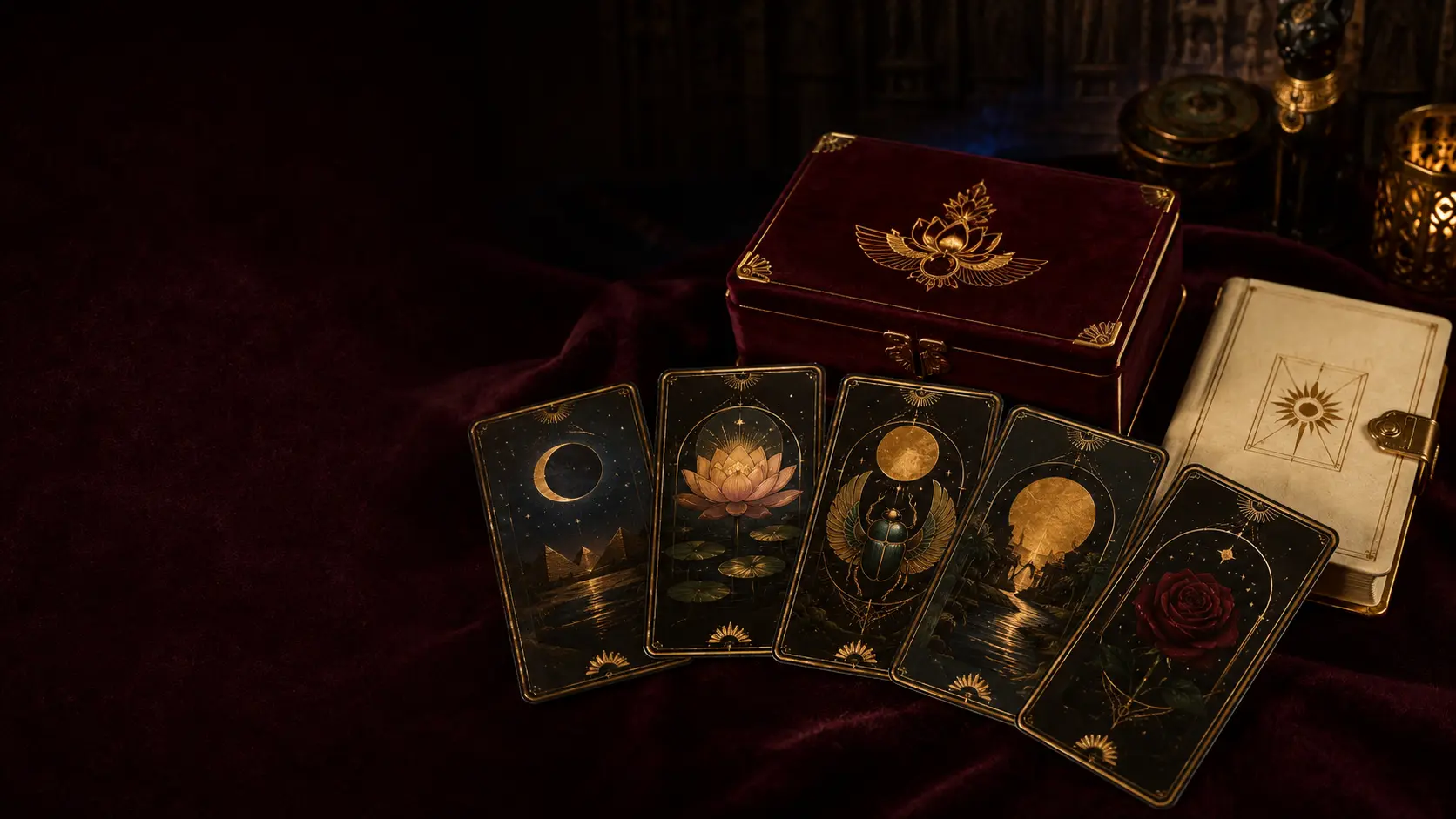
One card. One image. One new question. Tarot brings together play, art and interpretation. The Mystic Rose Oracle room welcomes three distinct decks, each with its own voice.
From Italian courts to the present
Early surviving tarot cards come from fifteenth-century Italy. They were used for play, with imagery familiar to the Renaissance world: rulers, virtues, celestial bodies and the turning points of human life.
In late eighteenth-century France, tarot developed a divinatory and esoteric interpretation tradition. Published in 1909, the Rider–Waite–Smith deck gave the minor arcana narrative scenes through the work of artist Pamela Colman Smith. Her visual language continues to influence deck design.
The classical deck
A classical tarot deck contains 78 cards: 22 major arcana and 56 minor arcana. The minor arcana comprises wands, cups, swords and coins or pentacles. Each suit has ten numbered cards and a page, knight, queen and king. In contemporary readings, these suits are often associated respectively with action, feelings, thought and material life.
Heredith · Created by Heiti Kender
Heiti Kender is the programmer and author of Heredith. Heiti created the application using classical 78-card tarot as its foundation. This work brings card interpretation into an interactive digital setting.
His LinkedIn profile highlights experience at Dark Math Games and work in writing, content strategy and project management.
How to approach a reading
This introductory guide, edited by Mystic Rose, offers a way to frame a question, look closely at a card and record your reflections. It is our suggested reading practice; follow the application’s on-screen instructions for its particular spreads.
- Frame one open question, such as: ‘What could I pay attention to in this situation?’
- Open Heredith and follow the application’s reading instructions. Record the cards drawn and their positions.
- Look at the image first: its figures, direction and the detail that catches your attention. Then read the interpretation.
- For a three-card reflection, you may choose positions before drawing: situation, perspective and next step. This is an optional reflective exercise.
- Write down one observation and one small action. The cards offer symbols and questions; your choices remain yours.
Cleopatra Taro Deck · A 39-card system
Cleopatra is a separate original 39-card deck in development at Mystic Rose. Its introductory framework gives each card a symbol, light, shadow and a ‘Queen’s Step’: a small practical action. Light invites attention to possibilities; shadow invites reflection on a tension or habit; the step brings the reflection into everyday life. The deck has three houses of 13 cards: Gold focuses on action, Nile on feeling and timing, and Veil on taking a closer look.
Mystic Rose Oracle Taro Deck 22
Our first interactive 22-card deck is a distinct work, available to explore in the Mystic Rose Oracle room.
Editorial note: Heredith: author and programmer Heiti Kender. Guide writing and editing: Mystic Rose. Cleopatra: an original Mystic Rose deck in development.